


The Atlas Engine
Comfort preferences are saved in this browser. Resume position returns to a saved position; Continue reading opens a saved episode. Guests can choose device-only remembering below. Signed-in progress remains attached to the existing account. Public account registration is closed.
Optional, on this browser and device only. Save up to 50 series. Each place expires 90 days after its last update. Remembering switches off after 90 days without a saved movement or an enable or clear action. Your saved places are not sent to an account or analytics. Remembering and Resume work on individual chapter pages, including Webtoon flow. They pause in full screen and automatic whole-series reading. After additional chapters load, reopen a chapter page to resume saving.
Webtoon flow joins the images without page labels or gaps. Turn it off to return to the standard view. Full screen remains available for enlargement.
The original report exposes a missing unit. The apprentices repeat the observations and ask Vale to keep uncertain reports visible.
100 centimetres equal 1 metre, so 300 cm equals 3 m. A copied value of 300 m means a different distance. Repeated observations of 298, 300 and 302 cm have an observed range of 4 cm; three readings do not prove an exact position. Keep the unit, marked reference point, direction and date with the report.
Before you begin: Reading simple measurements, centimetres and metres, subtraction and checking the date of evidence.
A report says 250 cm. How many metres is that?
250 cm equals 2.5 m: two metres and fifty centimetres.
Suggested reading age: 9-11. This fantasy story revisits selected primary learning ideas; it is not a complete curriculum. Floating islands and the Atlas Engine are fictional. Independent educator review and reader testing are pending.
Page 1
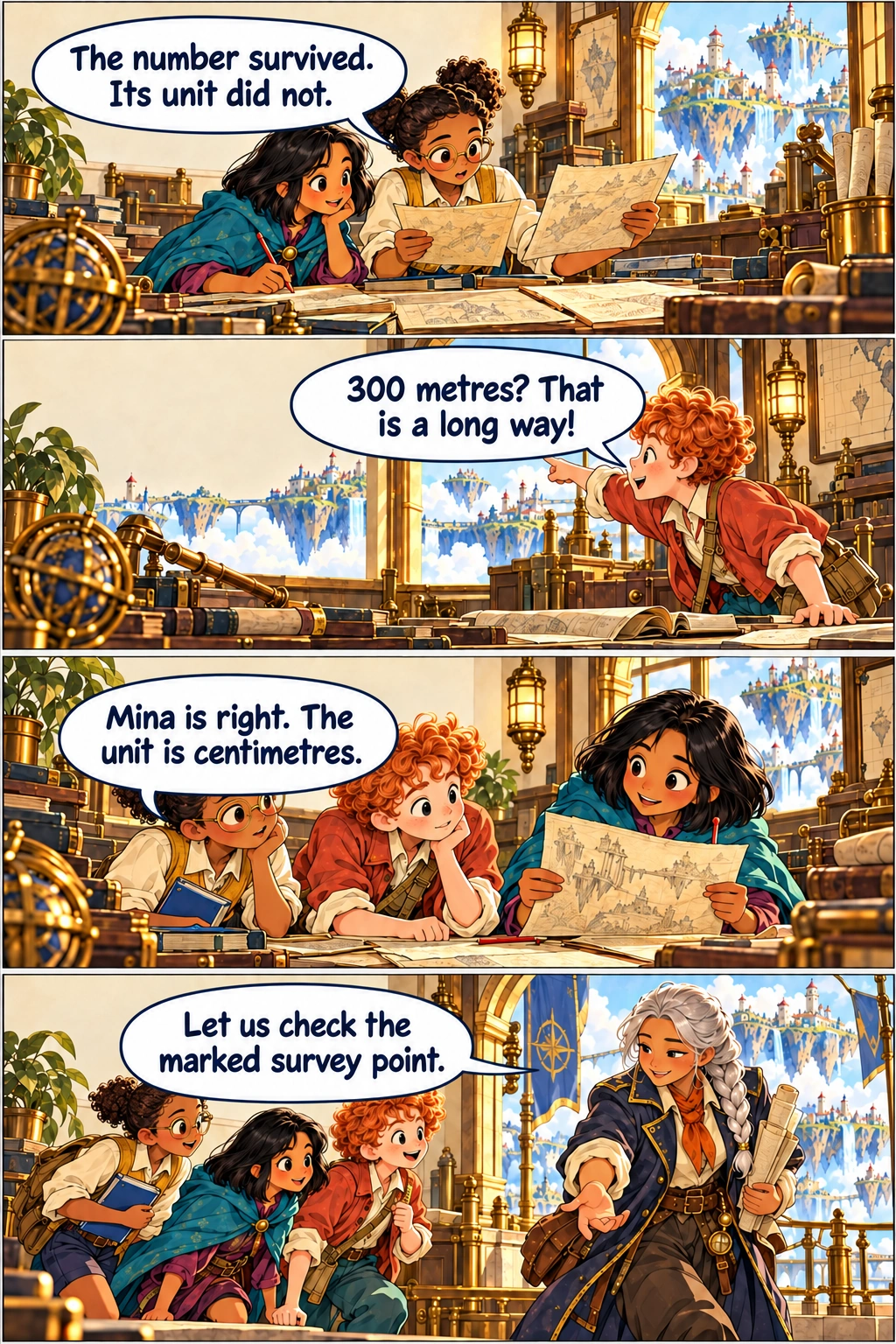
Panel 1: Ada compares two paper records on the Brindle report desk; Mina is beside her.
Ada: "The number survived. Its unit did not."
Panel 2: Kit looks from a paper report to the distant islands through a window.
Kit: "300 metres? That is a long way!"
Panel 3: Mina holds the original report, insisting calmly while her friends listen.
Ada: "Mina is right. The unit is centimetres."
Panel 4: Captain Sora gathers the original records beside the three apprentices.
Sora: "Let us check the marked survey point."
Page 2
Panel 1: Mina points to a teaching board showing 100 cm = 1 m, 300 cm = 3 m and that 300 m is a different distance.
Mina: "Keep the unit."
Diagram: 100 centimetres equal 1 metre, so 300 cm equals 3 m. A copied value of 300 m means a different distance. Repeated observations of 298, 300 and 302 cm have an observed range of 4 cm; three readings do not prove an exact position. Keep the unit, marked reference point, direction and date with the report.
Panel 2: Ada gestures across a short marked baseline on a safe broad Brindle terrace.
Ada: "300 centimetres. Only three metres."
Panel 3: Kit studies the two records with a rueful expression, Mina beside him.
Kit: "I copied the number without its meaning."
Panel 4: Mina smiles kindly at Kit while Ada opens her notebook.
Mina: "Then ask. The unit is part of the answer."
Page 3
Panel 1: Sora checks a secured measuring reel on a broad flat terrace with a marked brass survey peg; children observe from safe positions.
Sora: "Same point. Same direction."
Panel 2: Ada records a first reading while Sora operates the measuring reel.
Ada: "298 centimetres."
Panel 3: Kit reads the measuring indicator held by Sora, holding his pencil ready.
Kit: "This one is 300 centimetres."
Panel 4: Mina checks another reading; Sora holds the reel and Ada records it.
Mina: "And this one is 302 centimetres."
Page 4
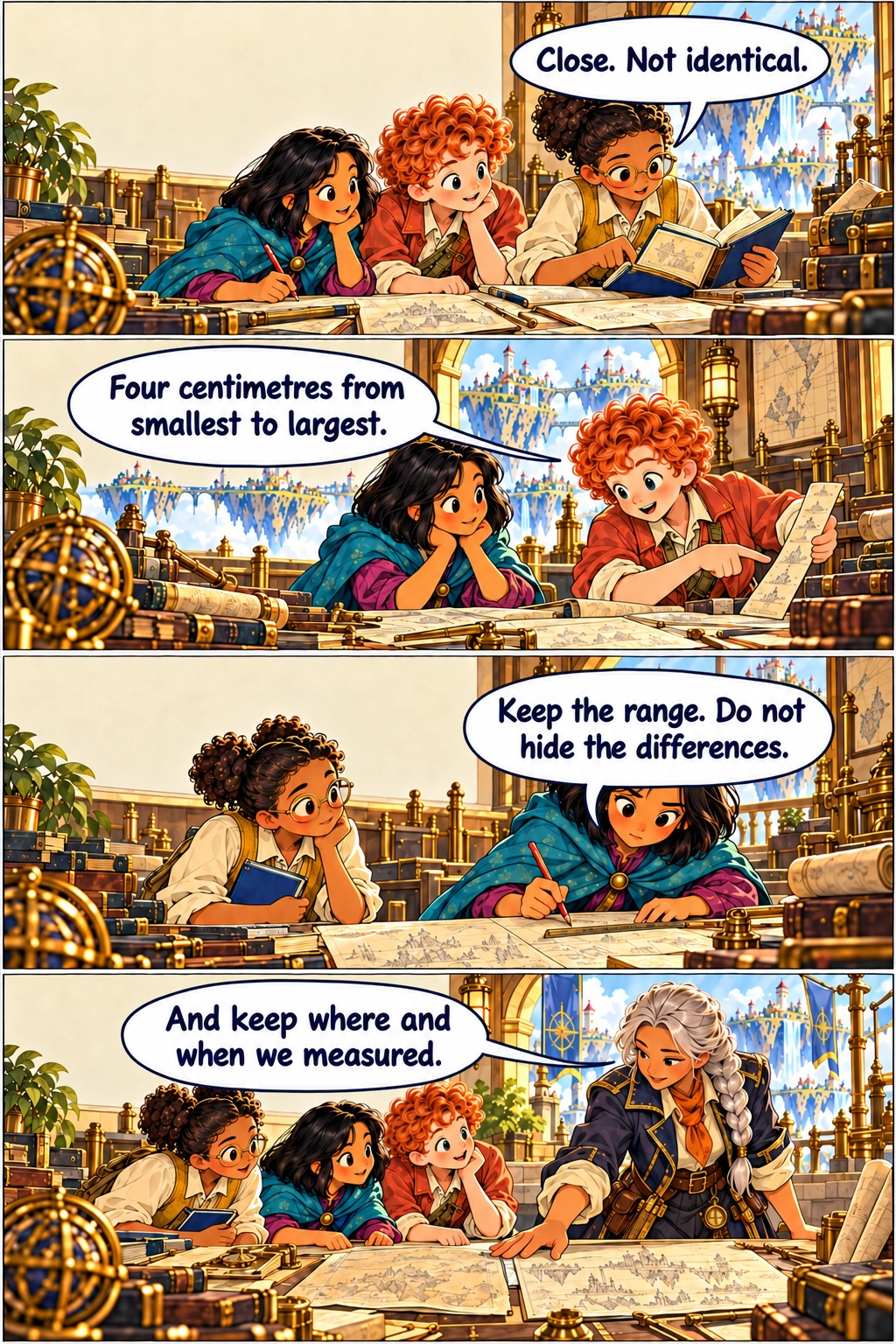
Panel 1: Ada compares the three entries in her blue notebook, friends beside her.
Ada: "Close. Not identical."
Panel 2: Kit counts the spread using a small paper strip; Mina listens.
Kit: "Four centimetres from smallest to largest."
Panel 3: Mina presses her red pencil beside the measurement record as Ada nods.
Mina: "Keep the range. Do not hide the differences."
Panel 4: Sora sets the original report next to the new dated observations, terrace behind.
Sora: "And keep where and when we measured."
Page 5
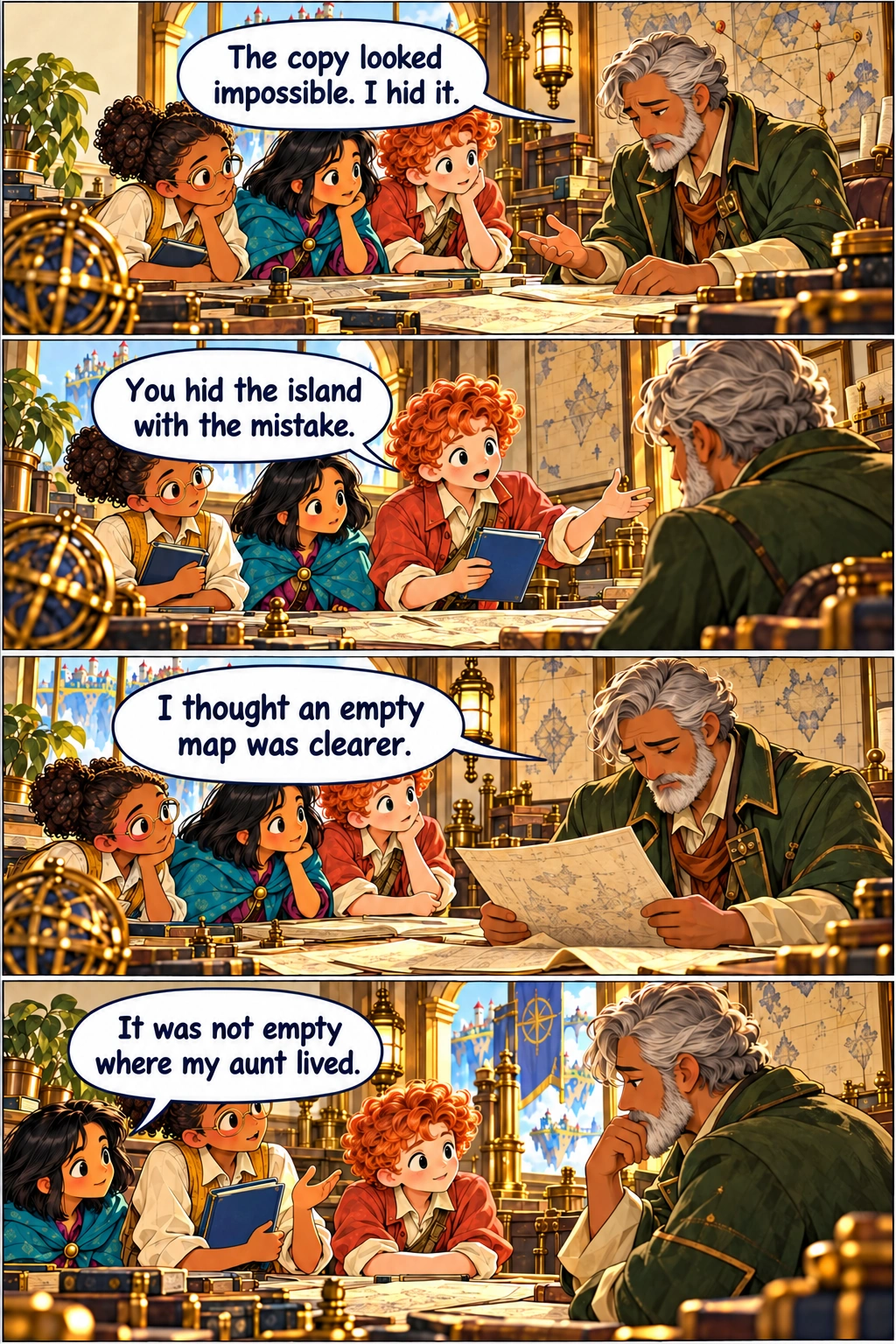
Panel 1: Mapkeeper Vale, an older tawny-skinned man with grey beard and moss coat, sits at the report desk facing the three children and Sora; warm brass map machinery behind.
Vale: "The copy looked impossible. I hid it."
Panel 2: Kit addresses Vale, holding Ada's blue notebook; Ada and Mina listen beside him.
Kit: "You hid the island with the mistake."
Panel 3: Vale looks regretfully at a chart while Sora listens without anger.
Vale: "I thought an empty map was clearer."
Panel 4: Mina faces Vale calmly, emergency lantern visible in the background.
Mina: "It was not empty where my aunt lived."
Page 6
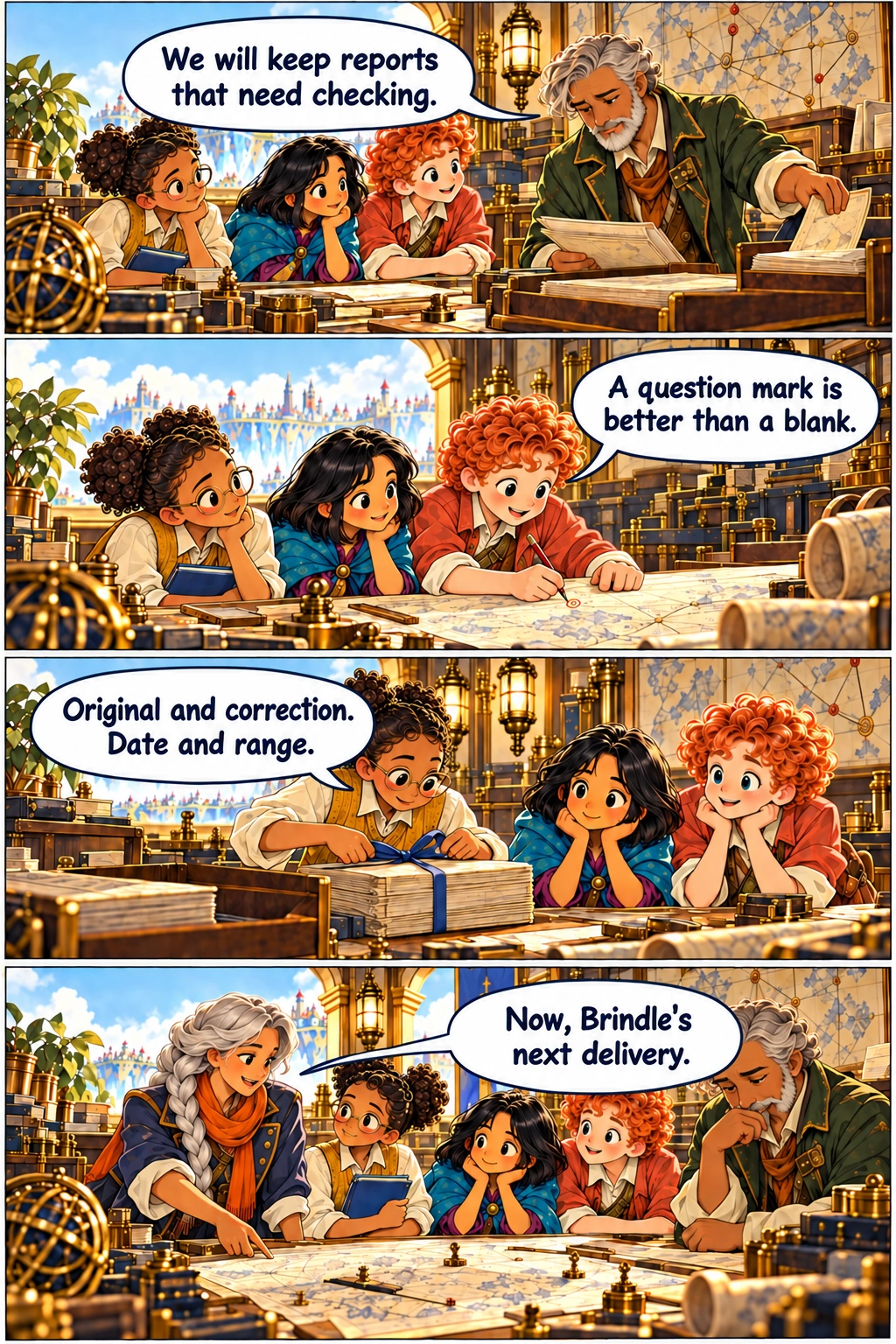
Panel 1: Vale puts a new report card into a clearly visible separate tray beside the accepted charts.
Vale: "We will keep reports that need checking."
Panel 2: Kit adds a small pencilled mark to an unlabelled draft map while Ada watches.
Kit: "A question mark is better than a blank."
Panel 3: Ada ties the original and corrected reports together with a blue ribbon.
Ada: "Original and correction. Date and range."
Panel 4: Sora and the apprentices stand at the report desk, reviewing a fresh route chart with Vale.
Sora: "Now, Brindle's next delivery."
Save and Follow mark this series in this browser. Select an active button again to remove the mark. They do not send email alerts. Clearing browser storage removes guest marks.
Reader ratings
Judge the story, artwork and reading experience. Your series rating covers what you have read so far; you can update it after another episode.
Studio original. Production notes
Loading reader scores...
Choosing to rate creates a first-party rating cookie for up to 365 days. It lets this browser change or remove its scores. No name, email or written review is requested. How ratings work
Compare reader ratings. Studio comics remain free to read, whatever score they receive.
Comments are closed for this comic.